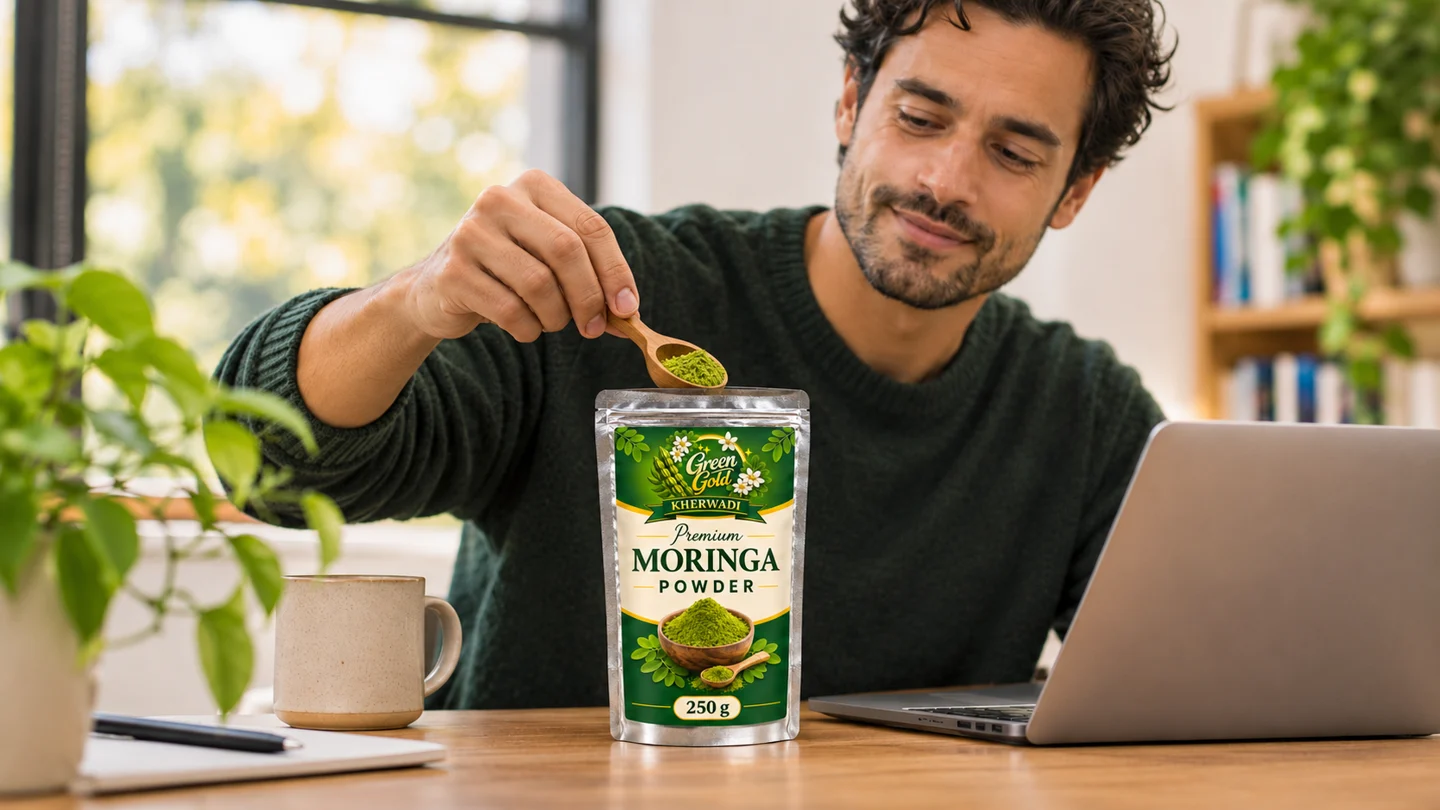

Stir one teaspoon (2–3 g) into water, juice or a smoothie. For a savoury option, mix it into a soup, curry or salad dressing.
As more people rave about green superfood powders, here are a few tips for how you can use your senses to determine the quality of your moringa. Feel free to leave a comment or question below!
1. Know where your moringa comes from and how it is grown
Stir one teaspoon (2–3 g) into water, juice or a smoothie. For a savoury option, mix it into a soup, curry or salad dressing.
Stir one teaspoon (2–3 g) into water, juice or a smoothie. For a savoury option, mix it into a soup, curry or salad dressing.
The three key aspects that are examined are:
1) plant soil quality
2) careful drying processing
3) certified product quality
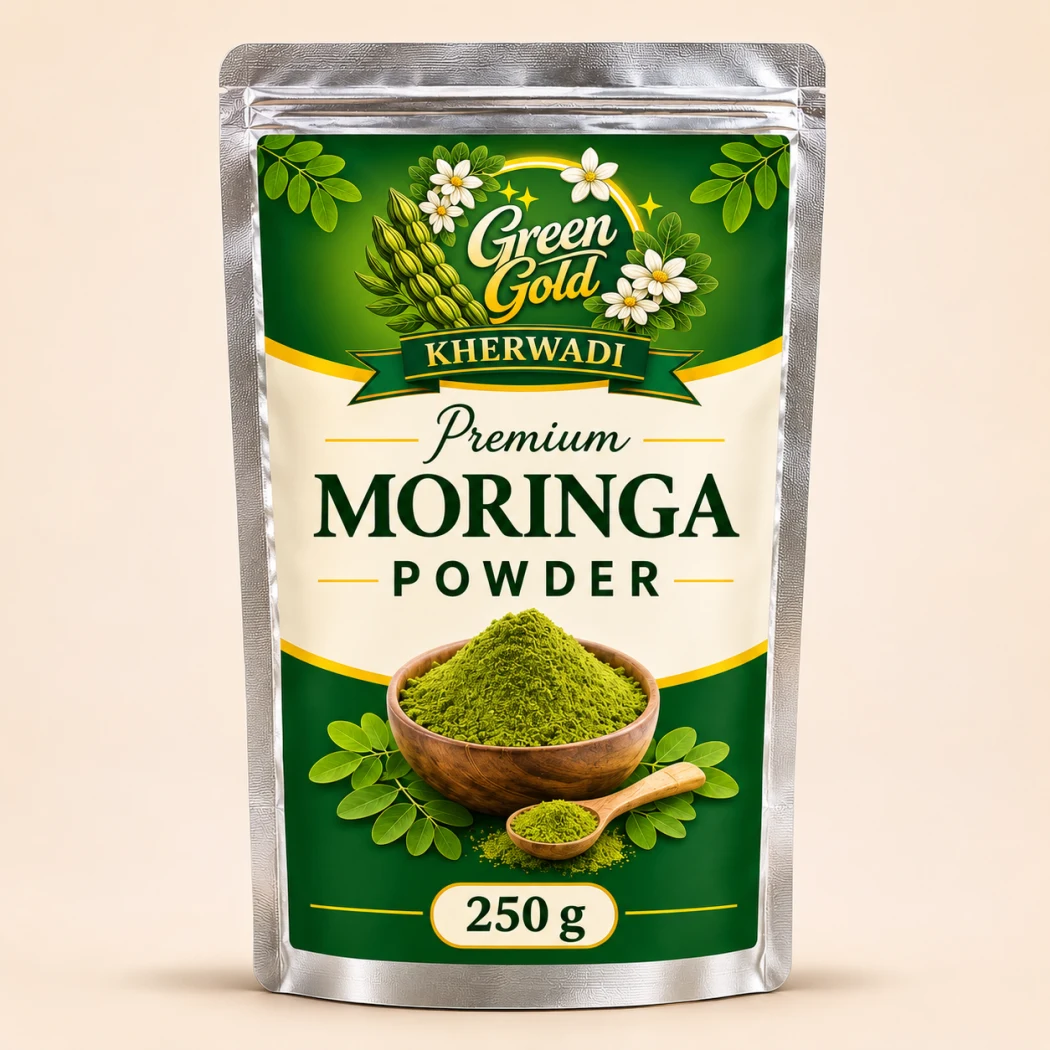
Green Gold Kherwadi makes moringa powder and herbal teas in Kherwadi, in the Vadodara district of Gujarat. Our Premium Moringa Powder is made with shade-dried moringa leaves. The powder comes in 250 g, 500 g and 1 kg packs.
2. Trust the brand and its certifications
Green Gold Kherwadi makes moringa powder and herbal teas in Kherwadi, in the Vadodara district of Gujarat. Our Premium Moringa Powder is made with shade-dried moringa leaves. The powder comes in 250 g, 500 g and 1 kg packs.
Stir one teaspoon (2–3 g) into water, juice or a smoothie. For a savoury option, mix it into a soup, curry or salad dressing.

Green Gold Kherwadi makes moringa powder and herbal teas in Kherwadi, in the Vadodara district of Gujarat. Our Premium Moringa Powder is made with shade-dried moringa leaves. The powder comes in 250 g, 500 g and 1 kg packs.
3. A Matter of Taste: Is Bitter Better?
Why do people love this amazing plant even though it has a strong, vegetal taste? The communities that live where moringa thrives have traditionally eaten Moringa oleifera and the other top two species (Moringa stenopetala and Moringa cancanensus) as food. While the seeds and stems provide many benefits, the leaves are mostly used for their antioxidant activity, high protein and vitamin levels.
The other ten moringa species are used for medicinal purposes only. [7] Why is that? Simply put, the bitter taste of many of those moringa species has encouraged people to use them for only medicinal purposes.
At the root of the bitter bite is actually the plant’s healing power via the activity of the glucosinolates, better known as mustard oils. These same compounds make cruciferous vegetables – broccoli, bok choy, cabbage, cauliflower, brussels sprouts, red cherry radish, daikon radish and watercress, etc. – big players in the game to prevent the development of chronic conditions, and moringa surpasses these and other greens, hands down!
Wild vs. Domesticated Moringa
Let’s briefly consider the differences between wild Moringa and domesticated Moringa. The majority of Moringa oleifera is from domesticated plants; however, the “wild” Moringa oleifera differs greatly from its domesticated offspring in ways that affect plant characteristics.[3] Gaining a deeper understanding of moringa’s evolution helps us to preserve positive traits when breeding plant species for optimal nutrition. This is akin to the benefits we receive from connecting with our own heritage to support lifestyle choices that are most beneficial to our unique body chemistry.
Glucosinolates (GS), more easily referred to as mustard oils, are the star plant-created ingredients (phytochemicals) that bring moringa’s healing power to the table while making their presence known with a slightly bitter taste or bite.
When we eat moringa, the plant enzyme myrosinase transforms the GS into isothiocyanates, the miracle workers that do a fantastic job of protecting our most precious asset – our health. The level of bitterness is directly related to Moringa’s two dominant GS types, meaning that moringa’s bite demonstrates its nutritional quality.

Today’s domesticated moringa is actually less bitter than its wild parent, yet the healing benefits are greater. In short, nature selected out the extreme bitterness over time to ensure greater plant use while improving on the plant’s ability to heal. That mildly spicy taste is just confirmation that the moringa is about to do some serious work to nourish and heal you!
The bottom line: we get incredible healing benefits from a slightly bitter plant that grows abundantly under the most difficult conditions. This is indeed a wonderful gift to be embraced for our health and healing, so bring on the bite!
The most nutritious moringa variety
Thanks to great strides that have been made in studies conducted by scientists Jed Fahey, Mark Olson, and Gwen Chodur, we now know there are three main Moringa species with the highest leaf nutrient concentrations. Moringa oleifera leads the way as the global favorite for general consumption due to its nutritional density and mustard oils (glucosinolates) which provide pathogen-busting power.[7]
Stir one teaspoon (2–3 g) into water, juice or a smoothie. For a savoury option, mix it into a soup, curry or salad dressing.
Moringa Heals
Moringa oleifera has been gaining well-deserved attention in recent years due to its rich nutrients and healing properties.[3] Since ancient times, countless individuals have reaped the benefits of making Moringa a part of their meals and medicines.
Its claim to fame includes the ability to successfully treat inflammation, parasitic diseases, joint pain, digestive disorders, hypertension, diabetes, anemia and skin conditions while providing cardiovascular and immune support, protecting against numerous pathogens (E. coli, Salmonella, Candida, H. pylori and Staphylococcus) and enhancing lactation for breastfeeding mothers. [4] [5]
So, why isn’t everyone making Moringa a part of their regular dietary regimen? Three key issues prevent people from consuming more moringa:

The need to gain further insight into the science behind Moringa’s benefits, The lack of awareness of moringa’s tremendous benefits and ease-of-use The matter of taste.
Stir one teaspoon (2–3 g) into water, juice or a smoothie. For a savoury option, mix it into a soup, curry or salad dressing.
For more highlights on moringa, please read our article on 10 Reasons to Eat Moringa Everyday, or The Science Behind Nourishing Immunity.
Stir one teaspoon (2–3 g) into water, juice or a smoothie. For a savoury option, mix it into a soup, curry or salad dressing.

Stir one teaspoon (2–3 g) into water, juice or a smoothie. For a savoury option, mix it into a soup, curry or salad dressing.
References
Anwar, F., Ashraf, M., & Muhammad, I. B. (2005). Interprovenance variation in the composition of moringa oleifera oilseeds from pakistan. JAOCS, Journal of the American Oil Chemists’ Society, 82(1), 45-51. Retrieved from https://search.proquest.com/docview/275086507?accountid=107221
Asghari, G., Palizban, A., & Bakhshaei, B. (2015). Quantitative analysis of the nutritional components in leaves and seeds of the persian moringa peregrina (forssk.) fiori. Pharmacognosy Research, 7(3) doi:http://dx.doi.org/10.4103/0974-8490.157968
Chodur, G. M., Olson, M. E., Wade, K. L., Stephenson, K. K., Nouman, W., Garima, & Fahey, J. W. (2018). Wild and domesticated moringa oleifera differ in taste, glucosinolate composition, and antioxidant potential, but not myrosinase activity or protein content. Scientific Reports (Nature Publisher Group), 8, 1-10. doi:http://dx.doi.org/10.1038/s41598-018-26059-3
Fahey, J. W., Olson, M. E., Stephenson, K. K., Wade, K. L., Chodur, G. M., Odee, D., . . . Hubbard, W. C. (2018). The diversity of chemoprotective glucosinolates in moringaceae (moringa spp.). Scientific Reports (Nature Publisher Group), 8, 1-14. doi:http://dx.doi.org/10.1038/s41598-018-26058-4
Leone, A., Spada, A., Battezzati, A., Schiraldi, A., Aristil, J., & Bertoli, S. (2015). Cultivation, genetic, ethnopharmacology, phytochemistry and pharmacology of moringa oleifera leaves: An overview. International Journal of Molecular Sciences, 16(6), 12791-12835. doi:http://dx.doi.org/10.3390/ijms160612791
Mendieta-araica, B., Spörndly, E., Reyes-sánchez, N., & Spörndly, R. (2011). Feeding moringa oleifera fresh or ensiled to dairy cows–effects on milk yield and milk flavor. Tropical Animal Health and Production, 43(5), 1039-47. doi:http://dx.doi.org/10.1007/s11250-011-9803-7
Olson, M. E., Sankaran, R. P., Fahey, J. W., Grusak, M. A., Odee, D., & Nouman, W. (2016). Leaf protein and mineral concentrations across the “Miracle tree” genus moringa. PLoS One, 11(7) doi:http://dx.doi.org/10.1371/journal.pone.0159782